Shorter cables
Short signal paths from collector to meter pick up far less noise than long runs to an external instrument.

Subproject · fA current sensing
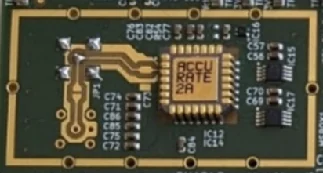
Between counting single particles and continuous current measurement lies a technology gap. With the ACCURATE 2A measurement ASIC on our polyimide laminates, we want to close it — directly in ultra-high vacuum.
Motivation
Detectors that count discrete charges work down to attoampere beams, and picoammeters measure continuous currents from about 10⁻¹² A upwards. In between — around one femtoampere — there is no established instrument.
Why in vacuo?
Today the collector signal leaves the chamber through a feedthrough and long cables before it reaches a meter on the air side. Bringing the measurement inside the vacuum vessel changes that.
Short signal paths from collector to meter pick up far less noise than long runs to an external instrument.
Fewer analogue signal lines running through the chamber mean less signal interference inside the vessel.
Measuring right at the source cuts measurement latency — the reading follows the experiment, not the cabling.
In-situ measurement needs fewer vacuum feedthroughs — fewer compromises in the chamber design.
Applications
Strategic fit
This subproject is our step from passive readout structures to active circuits inside the vacuum — alongside in-vacuo pre-amplifiers built from sealed transistors and, eventually, integrated circuits on our technology platform.
We are looking for partners in fA metrology and vacuum instrumentation — from beam diagnostics to coating process control.