UHV design criteria
Due to the absence of convective cooling, vacuum PCBs must be designed with careful attention to thermal management with low outgassing and bake-out compatible substrates.

TU Wien spin-off project · Patent pending
Invacuo makes custom printed circuit board solutions for ultra-high vacuum environments: high-fidelity device interfacing with low-outgassing and flexible substrates.
Milestones — hover a year
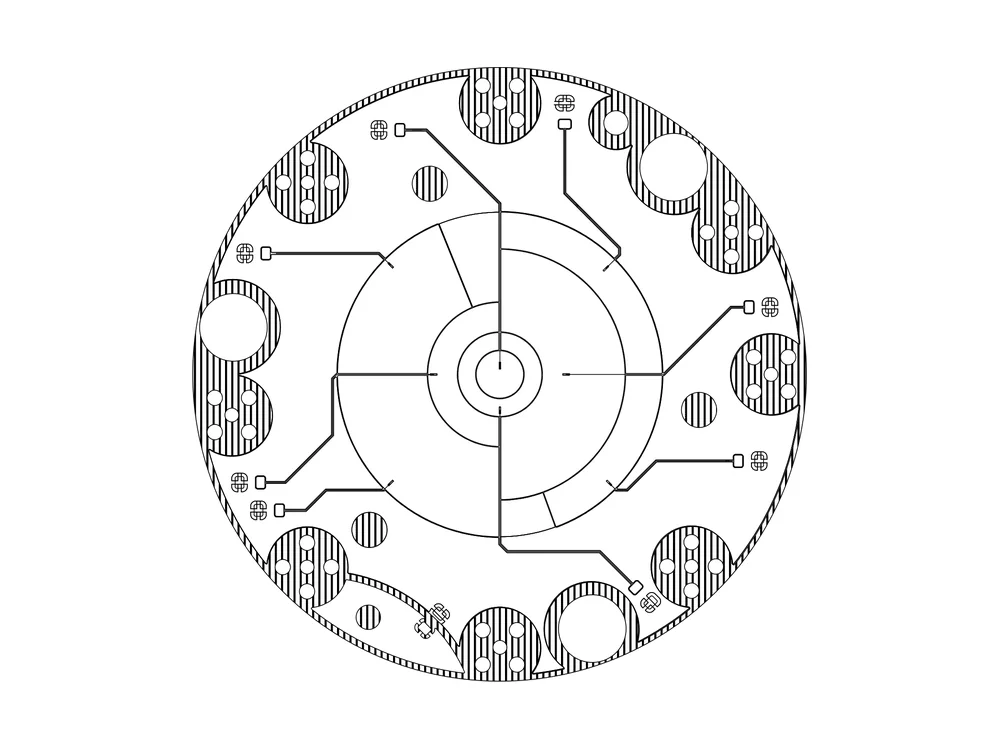
A UHV-compatible PCB anode emerges from a master thesis at TU Wien's Physics Faculty; a patent application follows at the Austrian Patent Office.

The Christian Doppler foundation selects the project for its Transfer.S2S programme.
Three years of funded research begin in January; the segmented polyimide-core anode is published in Review of Scientific Instruments (Kendler et al.).
Planned commercialisation as a TU Wien spin-off.
The mission
Standard printed circuit boards outgas under ultra-high vacuum and fail at high voltages or temperatures, so scientific instruments fall back on point-to-point wiring and ceramic parts. Invacuo develops circuit solutions that bring the design freedom of PCBs to scientific vacuum experiments and ultra-high vacuum production lines.
Due to the absence of convective cooling, vacuum PCBs must be designed with careful attention to thermal management with low outgassing and bake-out compatible substrates.
Vacuum based sensor and detectors pick up faint measurement signals, which rely on high-bandwidth signal readout circuitry to minimize signal attenuation and distortion. It is crucial to preserve signal integrity throughout the vacuum system, before amplification and evaluation can be performed on air.
Vacuum systems usually host multiple instruments confined to a small volume. Flexible PCB cables with click-on connectors simplify wiring and maintenance within intricate vacuum systems.
What we build
Capacitively coupled readout anodes for microchannel plates and channeltron particle detectors — including the segmented polyimide-core timing anode published in Kendler et al.
An ASIC femtoampere current-measurement chip deployed directly inside the vacuum, cutting leakage currents and signal interference to improve the accuracy of Faraday cups.
UHV-compatible printed 2D resonators on thin polyimide and LCP substrates. First application: a transmission electron microscope at USTEM, TU Wien.
Picosecond ion pulses generated by laser-stimulated desorption from a tungsten nanotip, as published in Redl et al.
Peer-reviewed
„Elektronik für Extreme: Signaltreue unter Weltraumbedingungen“
TU Wien announces four Transfer.S2S grants — among them Invacuo's programme on signal fidelity under space conditions.
The people
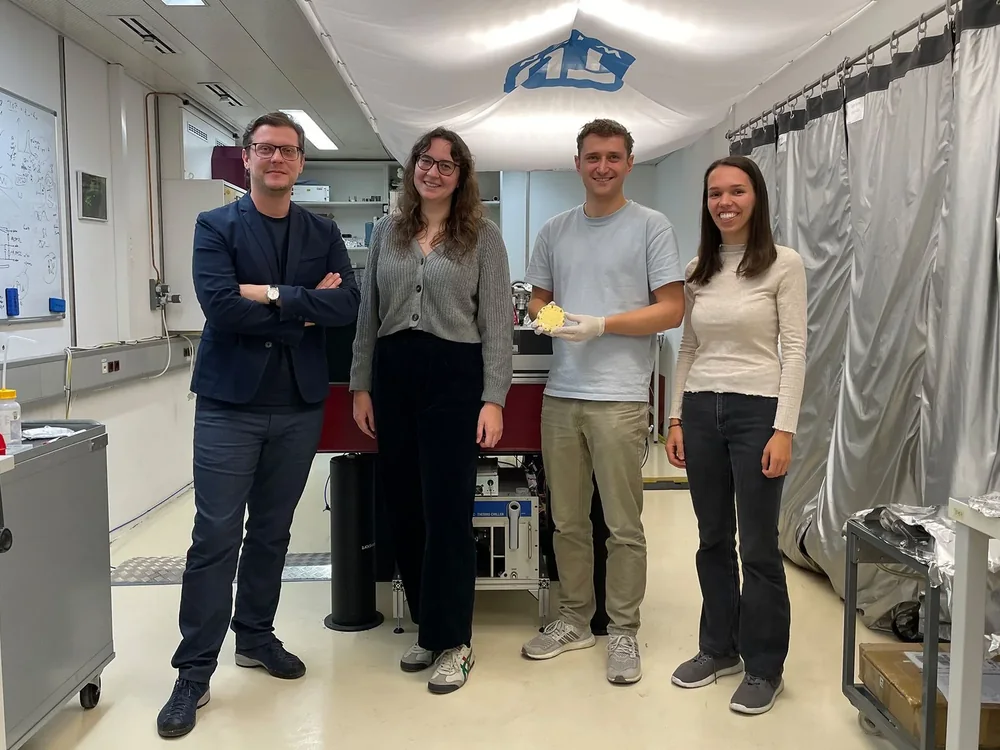
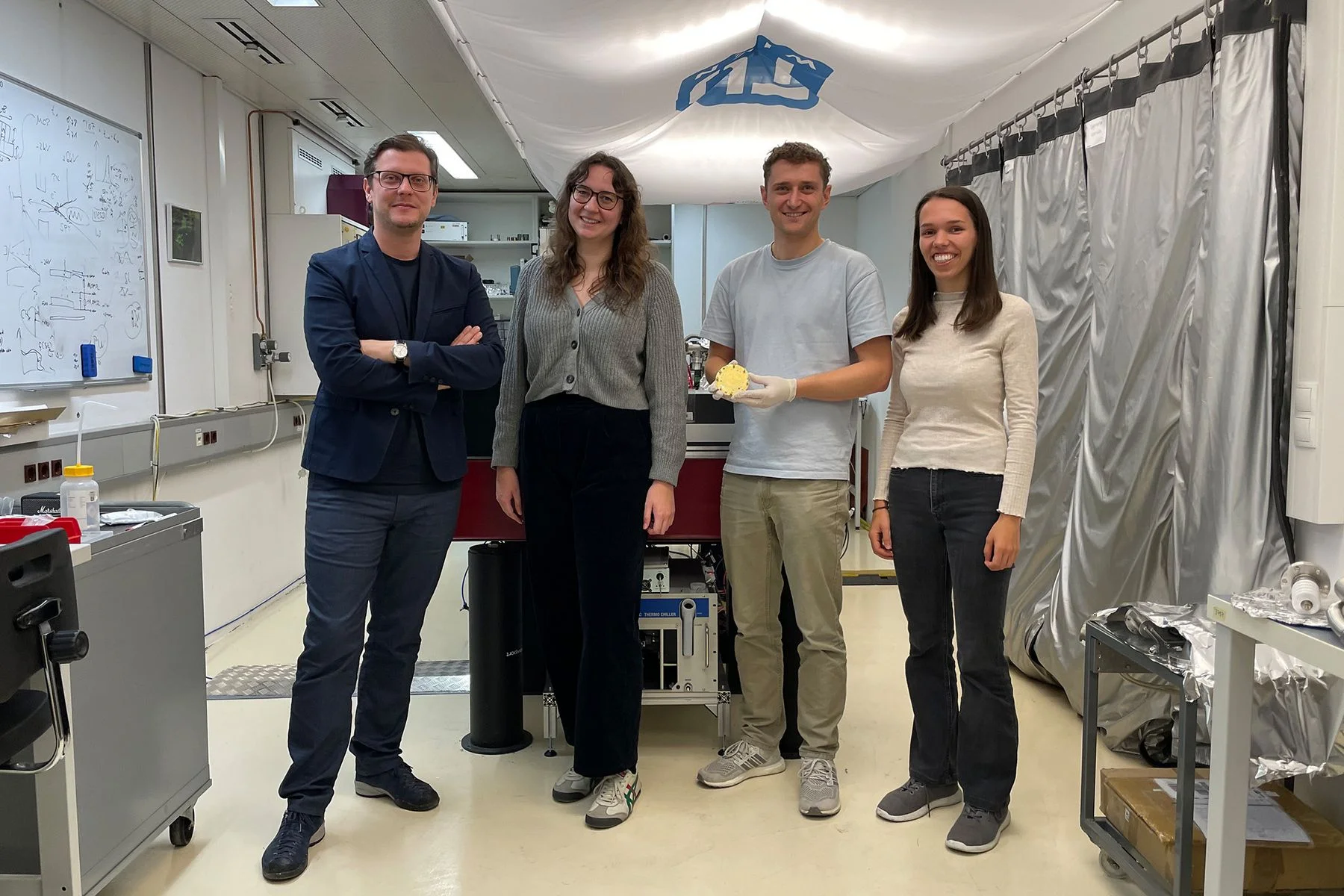
Invacuo grew out of the research unit of Richard A. Wilhelm at TU Wien. The Christian Doppler foundation's Transfer.S2S programme funds three years of research on the road to commercialisation.
Principal Investigator
PhD Student
PhD Student
PhD Student
Master Student
Master Student
Working with

Spin-off incubation

Research collaboration

CEM pilot project

RF antenna project
We are looking for partners in science and industry — for pilot projects, collaborations and early applications, from detector readout to flexible UHV cabling.